
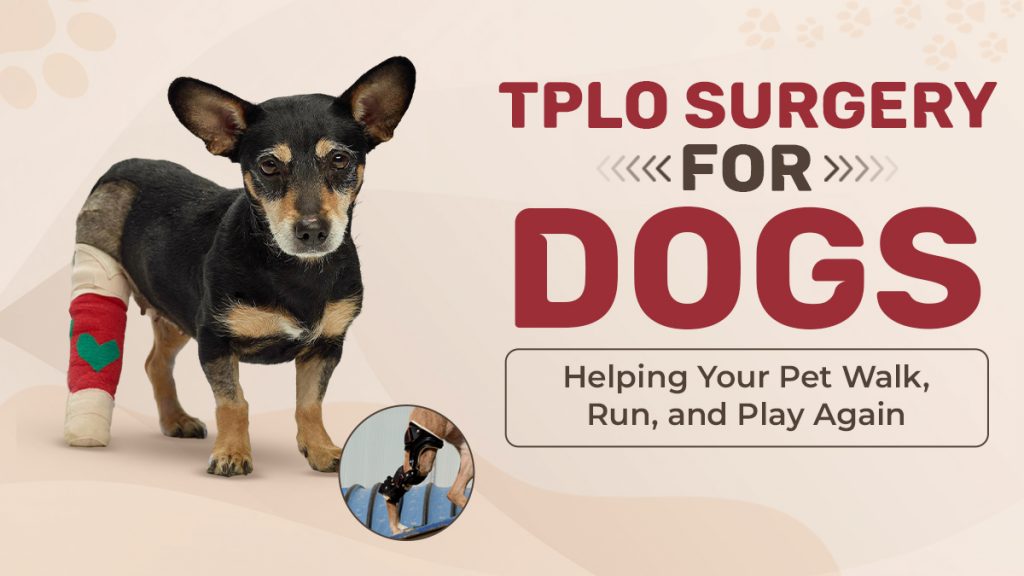

Watching your dog struggle to walk, run, or even stand properly due to a knee injury can be disheartening. If you find yourself in a similar situation, we’re here to tell you that your dog has a second chance at mobility. We’re talking about the TPLO surgery, a transformative procedure that helps dogs regain their movement.
This informative blog will walk you through TPLO (Tibial Plateau Leveling Osteotomy) surgery, including the fundamentals, procedure, and recovery to support long-term joint health. If your dog is facing a CCL (cranial cruciate ligament) injury, this guide will help you make informed decisions and offer the care they need to thrive again.
Let’s get started!
What is TPLO Surgery?
TPLO stands for Tibial Plateau Leveling Osteotomy. Don’t let these difficult-to-understand words scare you. TPLO is essentially a well-established surgical technique designed for dogs with a ruptured CCL (cranial cruciate ligament), similar to an ACL (anterior cruciate ligament) injury in humans.
As a consequence of the ligament tear, the knee joint becomes unstable, leading to pain, lameness, and often swelling. This surgery aims at preventing instability when your pet moves. How is it achieved?
Instead of replacing or repairing the torn ligament, TPLO changes how the knee bears the weight by changing the angle of the shin bone (tibia). This helps stabilize the joint without a functioning CCL and allows your dog to walk or run comfortably again.
When Does a Dog Need TPLO Surgery?
First of all, not all dogs with CCL injury will directly go into surgery. Before recommending the surgery, the vet considers several factors like:
- Age
- Dog size
- Weight
- Activity level
- Degree of tear
- Severity of lameness
Based on these observations, the vet will determine if the dog can benefit from conservative treatments like rest and physical therapy or if they require surgery. The TPLO surgery is recommended when a dog:
- Has a partial or complete tear of the CCL
- Is experiencing significant pain and discomfort.
- Has not responded well to the medications.
- Is medium to large in size with high activity levels.
How Does the Procedure Work?
In this segment, we’ll cover the step-by-step outline of how the TPLO surgery actually works.
- Pre-surgical planning: Before the dog is brought to the operating hall for surgery, specially positioned knee and leg X-rays are taken.
- Anesthesia and Preparation: The dog is gently anesthetized, while their vitals are continuously monitored. Then the surgical leg is shaved, and the skin is cleaned with an antiseptic to prevent infections.
- Incision: An incision over the knee is made to access the tibia, and the surgeon examines the joint and removes any torn fragments of the CCL.
- The Osteotomy (The Cut): The cut is the most crucial part of the surgery. A curved cut is made in the top of the tibia using a specialized, curved surgical saw. This cut is planned precisely, observing the pre-surgery X-rays.
- Rotation and stabilization: Then, the surgeon rotates the cut piece of bone to create a level angle where the femur and tibia meet. When the optimal level is achieved, a specially designed stainless steel plate with screws is used to secure the bone in its new place.
- Closure and monitoring: After examining the entire joint, the surgeon carefully closes the incision, and the dog is moved to a recovery area for monitoring and pain management.
Common Myths About TPLO Surgery (and the Truth)
Before we move forward to TPLO recovery, let’s quickly clear the air on a few misconceptions:
Myth: TPLO is only for larger and heavier dogs.
Fact: While TPLO was initially developed for large dogs, it’s also beneficial for small dog breeds.
Myth: Recovery from TPLO surgery takes forever.
Truth: While recovery from this surgery is gradual, most dogs begin walking within a few days, and with proper care, they return to normal activity within 3–4 months.
Myth: Dogs with ACL tears don’t always need surgery.
Truth: This is not true in most cases, as dogs have a steep tibial plateau angle, which leads to instability and pain from an ACL tear without surgery. Untreated ligament tears can lead to severe arthritis, meniscus tears, and chronic lameness.
TPLO Recovery: What to Expect
Recovery from TPLO surgery is a journey, but one that’s worth it. Here’s what a general timeline of TPLO recovery looks like:
Weeks 1–2: In the initial weeks, your dog will require the maximum amount of rest and confinement. Keep them indoors, on carpeted floors, and don’t leave them unsupervised. Allow only very short, slow leash walks for bathroom breaks. Keep the incision clean and dry, and keep your dog from licking it by using an E-collar.
Weeks 3-4: This period is critical for bone healing, so gradually increase the walking time to 10 to 15 minutes. Running, jumping, and stairs are still off-limits. Take follow-up vet appointments and X-rays to monitor the healing process.
Weeks 5-8: Typically, by this time, the vet recommends physical therapy as the focus shifts to rebuilding strength and restoring a normal range of motion. Increase leash walks to 20-30 minutes and indulge them in gentle, controlled exercises.
Weeks 9-12: By this time, the dog must’ve gained considerable strength and can return to normal off-leash activities as before, but only after the vet’s confirmation. You can increase the walking time and introduce moderate play sessions.
4-6 months: Congratulations, you’re nearing the finishing line! As per the muscle strength and joint stability, by this time, most dogs are cleared to return to full physical activity.
Long-term Joint Support After Surgery
Once your beloved dog is back on their paws, prevention becomes the priority. Here are some strategies to ensure long-term joint care:
- Weight management: Increasing weight and joint discomfort go hand in hand. Therefore, to avoid putting extra strain on your dog’s joints, feed them a balanced diet and watch their weight.
- Optimal exercise: Make sure your dog gets the much-needed mental and physical stimulation by indulging them in engaging activities and regular exercise. Create a training regime, covering activities like walks, swimming, fetching, etc.
- Joint supplements: To ensure your dog’s joints stay healthy and resilient, consider adding vet-approved joint supplements to their daily routines. Some popular options include GCS Joint Care Advanced Powder, Mobiflex Joint Care, Paw Osteosupport Joint Care Powder, etc.
Parting Words
All you need is the right knowledge and care, and TPLO surgery can be a turning point in your dog’s life. We have covered everything you need to know about this surgery, from its fundamentals and procedure to recovery and aftercare. It’s a promising option for restoring your dog’s mobility and quality of life. Whether they’re chasing squirrels or curling up beside you, they’ll be doing it pain-free and with joy.